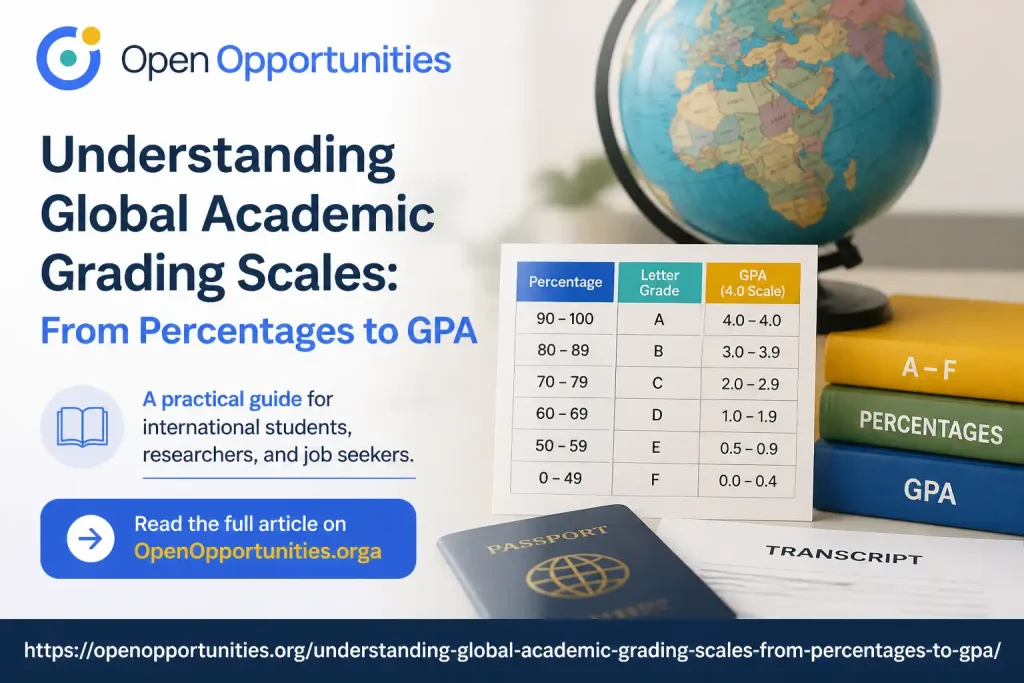
Navigating international education, global research collaborations, and cross-border career opportunities often begins with a single, complex challenge: understanding foreign academic credentials. Educational institutions and employers worldwide use drastically different methods to evaluate academic performance, ranging from simple percentage systems to cumulative Grade Point Averages and qualitative letter grades. For international students applying to universities abroad, researchers submitting credentials for fellowship applications, and job seekers moving across national borders, figuring out how a local grade translates into a foreign standard can feel like learning a new language.
This comprehensive guide breaks down the mechanics of various global grading frameworks, explains the limitations of direct mathematical conversions, and outlines the standard procedures used by admissions committees and credential evaluation agencies. While this guide provides practical strategies for interpreting academic records, it does not constitute official legal or immigration advice. Every institution maintains its own unique policies for transcript evaluation, making it essential to understand the underlying principles rather than relying on quick online conversion tools.
The Major Types of Global Grading Systems
Academic evaluation systems generally fall into four primary categories, each reflecting different educational philosophies and assessment styles. Understanding these categories helps clarify why transcripts look so different around the world and why simple conversions are rarely accurate representations of actual student achievement.
- Percentage Systems: Common in South Asia, parts of Europe, and the Middle East, these systems grade students on a scale from zero to one hundred, with specific cutoffs for passing, second-class, and first-class honors.
- Grade Point Average (GPA): Predominantly used in North America, this system assigns numerical values to letter grades, averaging them across all completed coursework to produce a cumulative score usually on a 4.0 scale.
- Letter Grade Systems: Used in various forms globally, these rely on alphabetical tiers from A through F to denote the level of mastery achieved in a specific course or module.
- Numerical Band Systems: Frequently found in the United Kingdom, Australia, and parts of Europe, these grade student performance using bands, such as First Class, Upper Second Class, or specific numerical intervals like 1 to 5 or 1 to 20.
Why Direct Conversion Fails
A common mistake among international applicants is attempting to convert foreign grades into a standard United States GPA simply by using mathematical proportions. For example, assuming that an 80 percent score automatically translates to a 3.2 on a 4.0 scale because 80 percent of 4.0 is 3.2 is fundamentally flawed. Academic rigor, grading strictness, and curriculum design vary wildly between institutions, states, and countries, making linear conversions completely unreliable for objective comparisons.
In many educational systems, achieving a grade above 75 percent is exceptionally rare, reserved only for the top fraction of a graduating class. If an admissions committee evaluated that 75 percent using a standard North American percentage scale, the student would appear to have a mediocre academic record, even if they finished at the absolute top of their cohort. Conversely, some educational environments feature rampant grade inflation, making high numerical scores less indicative of exceptional performance. Professional credential evaluation agencies account for these nuances by analyzing institutional context, grading distributions, and course syllabi rather than applying a blunt mathematical formula.
The Role of Professional Credential Evaluation Services
When applying for degree programs, research positions, or regulated professions abroad, candidates are frequently required to submit their transcripts to specialized credential evaluation agencies. These organizations analyze foreign academic records and translate them into a standardized format compatible with the destination country’s educational standards, ensuring that admissions officers and corporate recruiters can accurately interpret the applicant’s prior coursework.
Evaluations generally come in two primary forms: course-by-course evaluations, which list every individual course along with its equivalent credits and grades, and document-by-document evaluations, which simply verify the authenticity and equivalence of the completed degree. Because different institutions accept different evaluation services, applicants must verify which specific agency their target university or employer requires before paying for an assessment, avoiding wasted time and financial expenses.
Practical Checklist for International Academic Documents
- Verify the specific credential evaluation requirements of your target institution or employer before ordering any formal reports.
- Obtain official academic transcripts and degree certificates directly from your issuing institution, keeping them in sealed envelopes if required by the receiving organization.
- Secure certified English translations for any documents originally issued in another language, ensuring the translator uses recognized professional standards.
- Review your course syllabi and subject descriptions, as evaluators may request them to determine appropriate credit equivalencies and advanced standing.
- Maintain secure digital copies of all academic records, grading scales, and institutional handbooks explaining the historical grading criteria used during your enrollment period.
Common Mistakes to Avoid
Navigating transcript evaluations can be stressful, and avoidable errors often delay application processing times significantly. Being aware of frequent pitfalls can save valuable time and prevent unnecessary complications during your transition abroad.
- Relying on Unofficial Calculators: Using generic online GPA calculators without considering institutional grading scales leads to inaccurate expectations and poorly targeted applications.
- Ignoring Grading Scales: Failing to include the official grading scale or legend provided on the back of your transcript often forces evaluators to apply strict, unfavorable default interpretations.
- Delaying Translation: Waiting until the last minute to secure certified translations of academic records frequently results in missed deadlines for competitive fellowships and jobs.
- Assuming Universal Equivalency: Expecting every foreign university to interpret your home institution’s honors classifications in the same way can lead to unpleasant surprises during the admissions process.
Ultimately, understanding academic grading scales requires patience, research, and close attention to institutional detail. By recognizing the limitations of direct conversions, preparing official documentation thoroughly, and respecting the evaluation policies of your destination country, you can present your academic achievements accurately and effectively to a global audience of admissions committees and potential employers.