About the opportunity
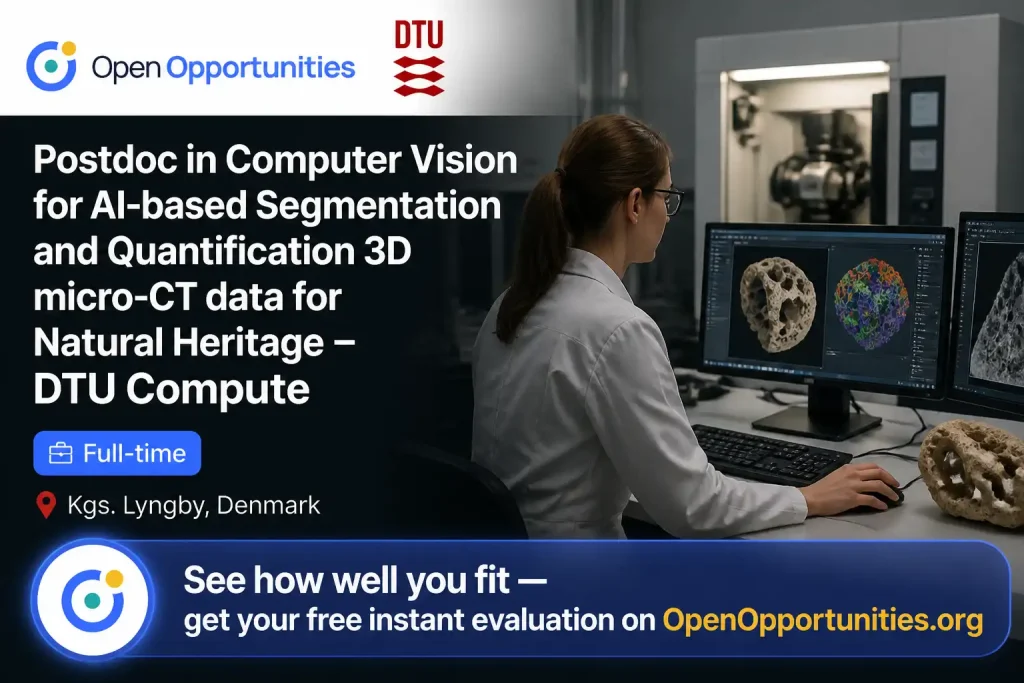
Are you excited about scientific AI and developing efficient computer vision methods for analysis of complex 3D scans of natural heritage samples? Join our interdisciplinary team as a postdoc to develop advanced segmentation and other analysis methods for a novel robotic micro-CT system that will transform how natural history collections are digitized and studied. You will have the opportunity to conduct high-impact research in computer vision for 3D volumetric images, contribute to widely used open-source software, collaborate with leading researchers in physics and natural history, and publish your work while helping build technology with lasting scientific impact.
Salary and benefits
- Competitive salary based on the collective agreement with the Danish Confederation of Professional Associations
- Negotiable supplements in accordance with DTU’s salary structure for scientific staff
- 2-year full-time employment period
- Involvement in strong collaborative research projects on both theoretical and practical imaging problems
- Participation in training and hackathon events as part of the QIM Center network
Who can apply?
- Hold a PhD degree in computer vision (ideally segmentation and/or quantification of micro-CT data) or equivalent
- If close to completing a PhD degree, include a written statement from the main supervisor confirming expected completion by 1 November 2026
- Experience developing deep learning-based image analysis methods
- Experience with scientific Python programming
- Experience handling both simulations and large real data
- Strong spoken and written communication skills in English
- Strong collaboration skills and being self-driven
Required documents
- Motivated application (cover letter)
- CV
- Academic Diplomas (MSc/PhD in English)
- List of publications
- Link to examples of scientific code developed by the applicant (e.g., GitHub link)
- Written statement from the main supervisor confirming expected PhD completion by 1 November 2026 (if close to completing)
When to apply
- Application deadline is 15 September 2026 (23:59 Danish time)
- Expected starting date is 1 November 2026 or soon thereafter
How to apply
- Prepare all required application materials in English as one single PDF file
- Open the 'Apply now' link on the official job page
- Fill out the online application form
- Attach the single PDF file containing all requested documents
Additional information
- The position is part of the 'Natural Heritage 3D' project, a collaboration between Visual Computing @ DTU Compute, DTU Physics, Copenhagen University, and the Natural History Museum.
- The role is part of the QIM Center for Quantification of Imaging Data.
- Open-source background checks may be conducted on qualified candidates due to research in critical technology subject to security and export control rules.
Our Take on This Opportunity
This section reflects Open Opportunities’ own analysis of the opportunity from an applicant’s perspective.
You may be a strong fit if…
- PhD holder in computer vision with specific expertise in segmentation or micro-CT data analysis
- Experience in deep learning-based image analysis and scientific Python programming
- Interest in interdisciplinary research bridging physics, natural history, and robotics
What should you think carefully about?
- The role is strictly on-site in Kgs. Lyngby, Denmark, requiring relocation if not already local
- Candidates must be prepared for open-source background checks due to the nature of the technology
- Applicants close to finishing their PhD must provide a supervisor statement confirming completion by November 2026
How could this fit your current goals and plans?
This two-year postdoc offers a high-impact opportunity to contribute to open-source software and publish research within a specialized robotic imaging project. It is ideal for a researcher looking to apply advanced computer vision techniques to real-world natural heritage digitization while building a professional network within the QIM Center.
Our take
Researchers with a strong background in 3D volumetric image analysis who want to see their work applied to large-scale scientific digitization should apply. Those seeking remote work or who cannot commit to the on-site requirement in Denmark will find this position unsuitable.
Ready to apply?
Review the opportunity on the official website before applying.
Official-source verified