About the opportunity
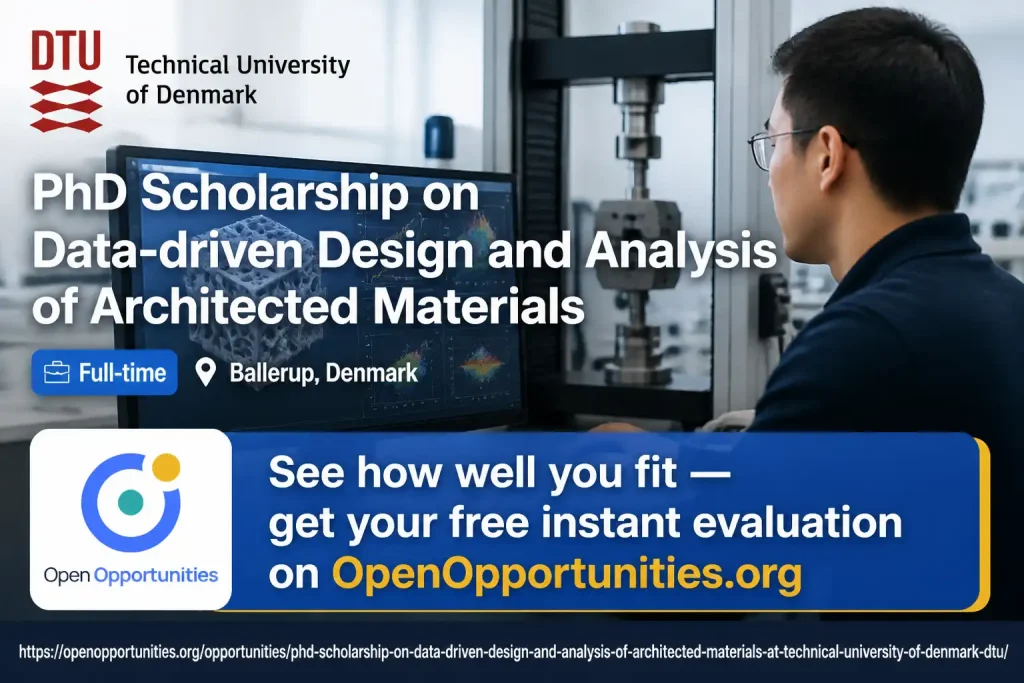
DTU Engineering Technology is offering a 3-year PhD position on the data-driven design and analysis of architected materials. Cellular architected materials, such as regular microlattices and stochastic foams, exploit programmed distributions of matter to attain superior mechanical, acoustic, and thermal properties. Tuning the meso-structure facilitates a materials-by-design approach, though morphological parameters present a significant hurdle. This project employs virtual structure generation, mechanics, and interpretable learning techniques to develop a rigorous, data-centric framework for ordered and disordered architected materials. Supervised by Associate Professor Stavros Gaitanaros, the successful candidate will work with colleagues at DTU Engineering Technology, DTU Construct, and international academic partners.
Salary and benefits
- Salary and appointment terms based on the collective agreement with the Danish Confederation of Professional Associations
- 3-year full-time PhD employment contract
- Access to a rewarding and challenging job in an international academic environment
- Option to join monthly free seminars regarding PhD relocation to Denmark
Who can apply?
- Must hold a two-year master's degree (120 ECTS points) or an equivalent academic level degree
- Ideal candidates should have prior experience with solid mechanics, materials, numerical techniques, and machine learning algorithms
- Experience in computational geometry, solid mechanics, geometric deep learning, and computational modelling or finite element analysis is advantageous
- Applicants may apply prior to obtaining their master's degree but cannot begin before having received it
- All interested candidates irrespective of age, gender, disability, race, religion, or ethnic background are encouraged to apply
Required documents
- Cover letter motivating the application
- Curriculum vitae (CV)
- Grade transcripts and BSc/MSc diploma in English
- Official description of grading scale
When to apply
- Application deadline is Friday, December 4, 2026, at 23:59 Danish time
- Expected starting date is March 1, 2027, or according to mutual agreement
How to apply
- Prepare all required application materials in English and combine them into one single PDF file
- Open the official application link and fill out the online application form
- Upload the single PDF containing all materials and submit before the deadline
Additional information
- Open-source background checks may be conducted on qualified candidates due to research in critical technology subject to special rules for security and export control.
- Further information can be obtained from Associate Professor Stavros Gaitanaros via email at staga@dtu.dk.
Our Take on This Opportunity
This section reflects Open Opportunities’ own analysis of the opportunity from an applicant’s perspective.
You may be a strong fit if…
- An ideal match for researchers with a background in solid mechanics, materials science, or scientific computing who want to branch into machine learning applications.
- Provides a structured 3-year runway embedded within a prominent European technical university with built-in international academic collaborations.
- Strong institutional support including salary coverage under collective agreements and dedicated relocation guidance for international applicants.
What should you think carefully about?
- Requires relocation to Denmark unless specific remote arrangements are authorized, though relocation support and seminars are provided.
- Applicants must possess or be very close to completing a full two-year master's degree (120 ECTS) equivalent before starting on March 1, 2027.
- Subject to security and export control background checks given the critical nature of the research technology.
How could this fit your current goals and plans?
This fully funded PhD position serves as a robust career stepping stone for individuals aiming to build a rigorous academic profile or high-level technical career at the intersection of advanced materials and artificial intelligence. The combination of computational modelling, machine learning, and experimental design delivers versatile, transferable competencies valuable in both academia and high-tech industries.
Our take
Strongly recommended for ambitious Master's graduates or early-stage researchers with quantitative backgrounds who are eager to commit to a 3-year deep-dive research project in Denmark. Those lacking background in solid mechanics or computational methods may find the technical scope challenging.
Ready to apply?
Review the opportunity on the official website before applying.
Official-source verified