Navigating international recruitment often brings a unique hurdle for global job seekers, researchers, and recent graduates: translating the value and legitimacy of a foreign university degree for a local hiring manager. When recruitment teams look at a resume featuring academic institutions from another country, they face complex questions regarding accreditation standards, grading scales, course equivalencies, and specialized professional licensing requirements. Understanding how hiring teams and corporate human resources departments decode foreign credentials helps you present your educational background in a transparent, easily digestible manner that builds immediate trust from the very first review. Without this foundational clarity, even highly qualified candidates can find their applications stalled in automated screening systems or rejected simply due to unfamiliar formatting.
Employers rarely possess exhaustive, institutional-level knowledge of every university system, grading scale, and degree classification across the globe. Consequently, they rely on standardized frameworks, specialized evaluation agencies, and internal compliance protocols to assess whether a foreign degree matches domestic educational benchmarks. By learning how these evaluation mechanisms operate, you can proactively address potential gaps in understanding, eliminate ambiguity, and position your qualifications competitively within a new regional job market. This proactive approach shows hiring managers that you understand local corporate expectations and are fully prepared to navigate the administrative realities of cross-border employment.
The Role of Credential Evaluation Services
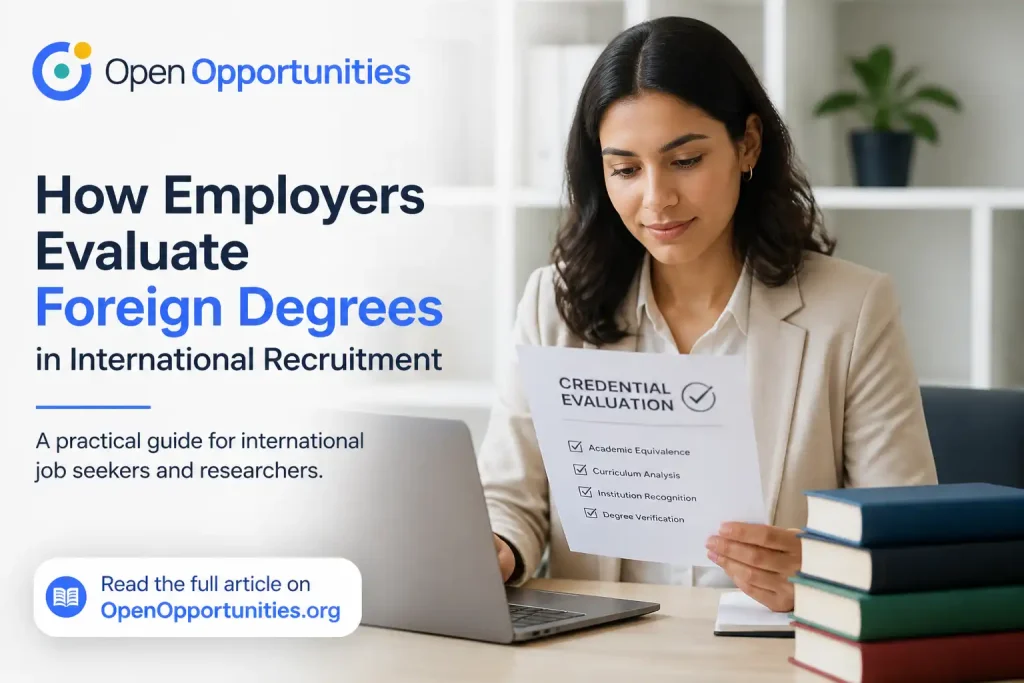
In many corporate environments, research institutions, and academic organizations, submitting a basic translated transcript is simply insufficient for formal hiring screening. Employers often require formal credential evaluations provided by recognized evaluation agencies to verify academic equivalence. These professional organizations analyze foreign transcripts and diplomas to determine exact degree equivalency, grade point average conversions tailored to local grading systems, institutional accreditation status, and course-by-course breakdowns for specialized technical roles.
Securing an official evaluation report before applying for competitive roles can dramatically accelerate your hiring timeline. It removes the guesswork for busy hiring managers and demonstrates professionalism, thoroughness, and absolute preparedness. When recruiters do not have to spend days researching foreign school rankings or trying to convert a complex percentage-based grading system into a standard four-point scale, they can focus entirely on evaluating your professional competencies, cultural fit, and technical portfolio.
Curriculum Mapping and Skill Translation
Beyond formal credential recognition, hiring managers look closely at the specific coursework, methodologies, and practical projects embedded within your degree program. Different educational systems prioritize different pedagogical approaches; some emphasize rigorous theoretical research and comprehensive written exams, while others focus heavily on practical internships, laboratory hours, and cooperative education. To bridge this gap successfully, candidates must translate their academic experiences into language that resonates directly with local industry standards and job descriptions.
When updating your resume or CV, avoid simply listing foreign course titles that lack context for local readers. Instead, include brief descriptive bullet points that highlight relevant technical skills, software proficiencies, capstone projects, and major research outcomes. This contextualization allows recruiters to see the direct applicability of your academic background to the specific operational needs of the organization, proving that your education prepared you effectively for the challenges of the role.
Navigating Institutional Accreditation and Degree Durations
Another critical element in international recruitment is the structural difference in degree durations and naming conventions across various global regions. For instance, some countries offer specialized three-year undergraduate degrees, whereas other regions standardly feature four-year bachelor programs. Corporate recruiters and human resources departments must verify whether a shorter or differently structured degree satisfies the prerequisite educational threshold for a given position or subsequent internal professional licensing requirements.
During this review process, employers also cross-reference the awarding institution against international databases to verify official accreditation and institutional standing. Candidates can assist this process by explicitly noting their institution’s recognition status on their professional profiles or application documents, ensuring that compliance teams can easily cross-verify the legitimacy of the credentials without encountering roadblocks or administrative delays that could slow down your candidacy.
Pre-Application Preparation Checklist
- Research local credential evaluation standards relevant to your target country and industry sector.
- Obtain official, sealed transcripts and degree certificates directly from your university registrar.
- Secure certified professional translations if your academic documents are not written in the local language.
- Map your key coursework, practical training, and academic projects to the requirements listed in target job descriptions.
- Prepare concise, clear explanations for non-standard grading systems, unique degree structures, or specialized thesis work.
Common Mistakes to Avoid
Many international candidates unintentionally create friction in the recruitment process through preventable oversights. Avoid simply guessing your local grade point average equivalent, as misrepresenting academic performance can lead to immediate disqualification during mandatory background checks. Similarly, do not assume that a globally renowned university name speaks entirely for itself; human resources professionals still require clear documentation of degree equivalence for corporate compliance and auditing purposes. Finally, resist the urge to omit your graduation date or academic details out of fear of age or international bias, as transparency is essential for building long-term credibility with hiring teams.
Ultimately, successfully marketing a foreign degree in international recruitment is an exercise in effective translation—not just of language, but of institutional trust, skill sets, and academic rigor. By anticipating the questions hiring managers will ask, securing the appropriate third-party verifications, and framing your educational achievements through the lens of local industry needs, you can transform your international background into a distinct professional advantage. Approach the evaluation process as a collaborative step that reassures employers, validates your hard-earned credentials, and clears the path for a successful career transition.