When navigating international career markets, applicants often stumble over a critical document transformation: shifting from an academic curriculum vitae to a corporate resume. While these terms are sometimes used interchangeably in casual conversation, hiring managers and academic search committees look for fundamentally different indicators of capability. Understanding these distinctions is essential for international students, researchers, and global job seekers who must pivot between higher education and industry sectors without losing their professional narrative.
The modern global economy demands flexibility, and many highly trained individuals find themselves exploring both academic and corporate pathways simultaneously or sequentially. This dual-track exploration requires maintaining two distinct application documents. An academic institution evaluates your potential to contribute to the global body of knowledge through teaching, grant acquisition, and peer-reviewed publishing. A corporate enterprise evaluates your ability to solve immediate operational challenges, manage project lifecycles efficiently, and contribute to organizational revenue or strategic goals.
Core Structural Philosophies
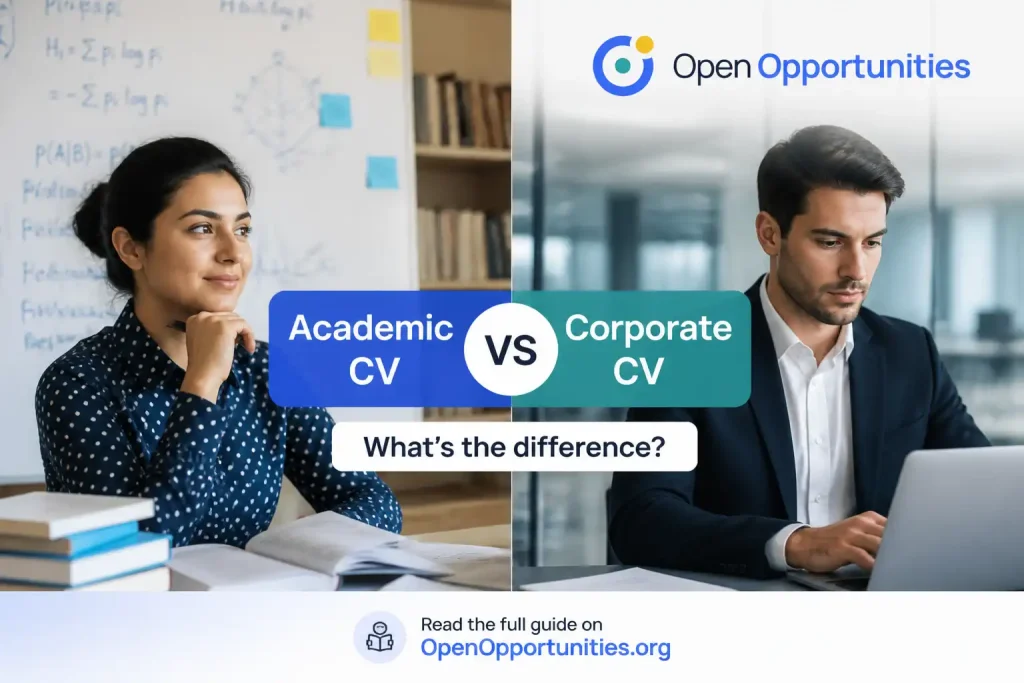
The primary divergence between an academic curriculum vitae and a corporate resume lies in length and scope. An academic curriculum vitae is a comprehensive, chronological record of your scholarly journey. It includes every peer-reviewed publication, conference presentation, teaching assistantship, grant, fellowship, and professional affiliation you have earned. There is typically no strict page limit, as evaluators want to see the complete trajectory of your scholarly output. Conversely, a corporate resume is a concise, impact-driven marketing document. Usually restricted to one or two pages, it is designed to give hiring managers a rapid snapshot of your most relevant skills, projects, and measurable achievements.
Key Architectural Differences
- Length: Academic CVs expand indefinitely with your career; corporate resumes maintain strict page limits.
- Focus: Academic CVs prioritize research, publications, and pedagogy; corporate resumes prioritize commercial outcomes, efficiency, and problem-solving.
- Objective: Academic CVs demonstrate scholarly potential and expertise; corporate resumes prove immediate value to a business operation.
- Tone: Academic CVs emphasize scholarly rigor and methodology; corporate resumes emphasize execution speed and business value.
Translating Academic Achievements for Industry
For researchers and doctoral graduates transitioning into corporate environments, the greatest challenge is translation. Academic culture values peer validation, methodology, and theoretical contribution, whereas the corporate sector values revenue growth, cost reduction, process optimization, and time-to-market. When adapting your application materials, you must reframe your laboratory discoveries or archival studies into transferable competencies. For example, managing a multi-year research grant is not merely an academic milestone; it is proof of rigorous project management, budget administration, risk assessment, and resource allocation. Similarly, supervising undergraduate students translates directly into cross-functional leadership, mentorship, and team development.
Translating these complex duties requires dropping esoteric academic jargon in favor of universally understood business terminology. If you spent years analyzing complex data sets for a university laboratory, a corporate employer wants to see data analytics, trend identification, and strategic recommendations rather than an exhaustive list of statistical software parameters. Bridging this communication gap allows international researchers to demonstrate that their advanced analytical training directly supports broader commercial objectives.
Essential Elements of the Academic Curriculum Vitae
If you are applying for post-doctoral fellowships, faculty appointments, or advanced research institutes, your curriculum vitae must follow established conventions. Search committees expect a predictable architecture that allows them to cross-reference credentials instantly. Begin with education, followed immediately by research interests, appointments, and publications categorized rigorously by type, such as peer-reviewed journal articles, book chapters, and conference proceedings. Subsequent sections should detail teaching experience, grants, awards, academic service, and professional memberships. Maintain a formal, objective tone throughout, ensuring all citations follow the standard academic style guide relevant to your discipline.
Clarity and thoroughness remain the twin pillars of a successful academic CV. Because search committees review hundreds of submissions, typography should remain clean and traditional. Avoid decorative elements, graphics, or color accents that distract from your scholarly record. Every entry must be verifiable, complete, and properly formatted according to the expectations of your academic field, whether that is APA, MLA, Chicago, or another recognized style framework.
Essential Elements of the Corporate Resume
Corporate recruitment relies heavily on applicant tracking systems and hurried human reviewers who spend mere seconds scanning a document. Your corporate resume must therefore be scannable, visually clean, and laser-focused on the specific job description. Start with a brief professional summary that highlights your core value proposition. Follow this with a dedicated skills section featuring both hard technical proficiencies and essential soft skills. Your professional experience section should not list routine duties; instead, use action verbs and quantify your results wherever possible. Frame each role around the problem you solved, the action you took, and the ultimate business outcome.
Unlike the exhaustive nature of an academic CV, a corporate resume demands ruthless curation. You should only include professional experiences, projects, and certifications that directly align with the specific vacancy you are targeting. Tailoring your resume for each application ensures that automated screening software and hiring managers immediately recognize your fitness for the role.
Practical Transition Checklist
- Audience Audit: Identify whether the target organization values peer-reviewed scholarship or commercial output before drafting your materials.
- Length Reduction: Distill an exhaustive multi-page history down to a punchy one or two-page corporate summary if applying to industry.
- Language Transformation: Replace academic jargon with standard industry terminology that non-specialist recruiters can easily understand.
- Metric Integration: Attach numbers, percentages, and tangible outcomes to your professional experiences rather than merely listing responsibilities.
- Formatting Review: Ensure clean typography, consistent spacing, and an ATS-friendly layout for corporate applications, or a traditional, structured layout for academic submissions.
Common Mistakes to Avoid
Job seekers frequently make critical errors when managing both document types. A common misstep in the academic sphere is submitting an unformatted or poorly organized curriculum vitae that buries significant publications beneath minor service roles. In the corporate sphere, the most frequent error is treating the resume like an autobiography. Including irrelevant personal data, outdated coursework, or listing every single conference attended without highlighting commercial relevance will quickly diminish your candidacy. Furthermore, failing to customize your application materials to the specific institution or company culture signals a lack of genuine interest and attention to detail.
Another frequent trap for international job seekers is assuming that foreign academic titles or institutional prestige will automatically translate without context. Always clarify the scope of your previous roles, the size of budgets managed, and the competitiveness of awards received. Providing clear context helps international hiring managers evaluate your true capabilities accurately.