About the opportunity
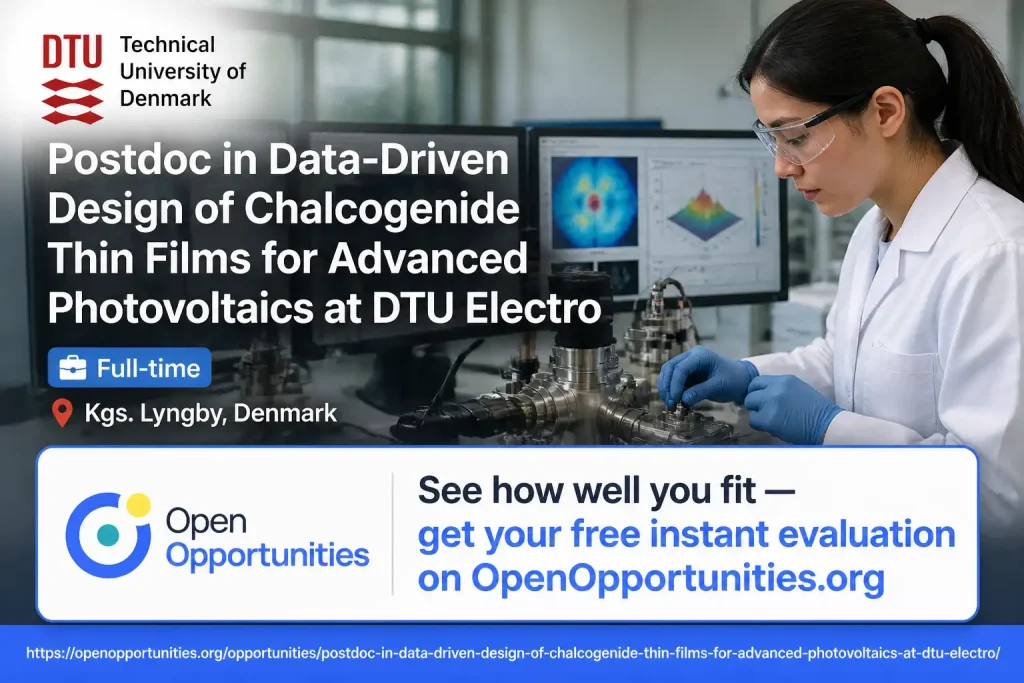
The Thin-Film Photovoltaics Group at DTU Electro is hiring a Postdoctoral Researcher to advance sustainable solar energy technologies. This role involves developing and optimizing hydrothermal synthesis of Sb2S3 and Sb2(S,Se)3 thin films, investigating defect formation, and fabricating solar cells. Funded by a Villum Synergy grant, the project is an interdisciplinary collaboration with DTU Compute, focusing on a closed-loop framework where experimental results inform machine learning models to guide synthesis. The researcher will work closely with computational experts to uncover relationships between synthesis conditions, material properties, and photovoltaic performance, while also contributing to teaching and student supervision.
Salary and benefits
- Two-year full-time employment contract
- Salary based on the collective agreement with the Danish Confederation of Professional Associations
- Opportunity to negotiate salary supplements according to DTU's scientific staff structure
- Work in an international, research-intensive academic environment
- Access to interdisciplinary collaboration between DTU Electro and DTU Compute
Who can apply?
- PhD degree (or equivalent) in physics, nanotechnology, materials science, electrical engineering, or a related field
- Hands-on experience in solar-cell fabrication, particularly with emerging photovoltaic technologies like halide perovskites or inorganic thin-film solar cells
- Strong academic background in relevant engineering or science disciplines
- Ability to work in an international, collaborative research environment
Required documents
- Cover letter (application)
- CV
- Academic diplomas (MSc and PhD in English)
- List of publications
- List of publications relevant to the position
- Letter of motivation explaining interest in the project and relevant technical skills
When to apply
- Application deadline: 15 November 2026 (23:59 Danish time)
- Start date: 1 January 2027
How to apply
- Prepare all required materials in English as a single PDF file
- Visit the official job portal via the 'Apply now' link
- Fill out the online application form
- Upload the single PDF file containing all required documents
Additional information
- The position is subject to security and export control rules due to the nature of the research
- Open-source background checks may be conducted on qualified candidates
- DTU is an equal opportunity employer encouraging all interested candidates to apply
Our Take on This Opportunity
This section reflects Open Opportunities’ own analysis of the opportunity from an applicant’s perspective.
You may be a strong fit if…
- Researchers with a background in thin-film synthesis and solar-cell fabrication who want to pivot into AI-integrated materials science.
- Candidates seeking a structured, two-year postdoctoral position at a globally recognized technical university.
- Individuals interested in interdisciplinary work bridging experimental physics and machine learning.
What should you think carefully about?
- The position is a fixed-term, two-year contract, which requires planning for subsequent career steps.
- Applicants must be prepared to relocate to Denmark, as the role is on-site at DTU Electro.
- The application process requires consolidating all documents into a single PDF, which must be strictly followed to be considered.
How could this fit your current goals and plans?
This role is an excellent opportunity for a recent PhD graduate to gain specialized experience in both advanced material synthesis and AI-driven experimental design. It provides a clear two-year window to produce high-impact research, build a publication record, and establish a professional network within a leading European technical university, which can serve as a strong foundation for either an academic or industry-focused career path.
Our take
This is a highly suitable opportunity for researchers with a strong foundation in materials science or photovoltaics who are eager to apply machine learning to experimental optimization. It is less suitable for those seeking permanent employment or those without prior hands-on experience in solar-cell fabrication.
Ready to apply?
Review the opportunity on the official website before applying.
Official-source verified