About the opportunity
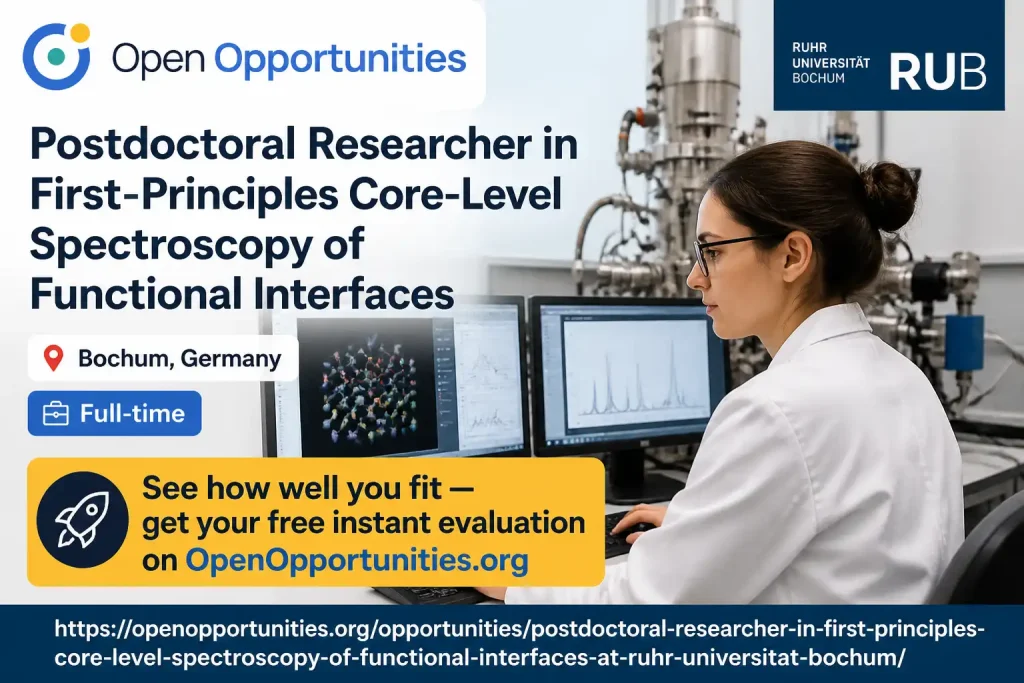
The successful candidate will join the research group of Prof. Silvana Botti at the Research Center Future Energy Materials and Systems (RC FEMS) and the Ruhr University Bochum (RUB). The group focuses on developing first-principles methods to describe electronic excitations, spectroscopic signatures, and structure–property relations in materials and at functional interfaces. This position aims to bridge the gap between existing bulk-focused approaches and the complex requirements of surfaces, interfaces, and defects in energy conversion and catalysis. The researcher will develop and extend ab initio methods for core-level spectroscopy, implement these in open-source software, and validate them against experimental data.
Salary and benefits
- Salary based on the collective agreement of the Länder (TV-L), typically pay grade E13
- Opportunity to shape a new research direction and contribute to collaborative research proposals
- Access to cutting-edge computational infrastructure, including local GPU clusters and national/European HPC resources
- Participation in an interdisciplinary and international research environment
- Professional development opportunities, including attendance at international conferences and workshops
- Support for language learning through free German or English courses
Who can apply?
- Master's degree and PhD in Physics
- Strong background in condensed matter physics and first-principles electronic-structure theory of solids
- Expertise in the theory and simulation of at least one core-level spectroscopy (e.g., XAS, XPS, or EELS)
- Experience with methods for correlated or open-shell systems beyond standard density functional theory
- High-level programming skills in Fortran and/or Python
- Demonstrated experience in developing computational methods and scientific software
- Ability to conduct independent research, evidenced by peer-reviewed publications
- Good command of English, both written and spoken
Required documents
- Cover letter
- Curriculum vitae
- Certificates (e.g., academic degrees, employment references)
When to apply
- Application deadline: 2026-10-20
How to apply
- Prepare all required application documents
- Submit the application via the official online application portal
- Reference the job number ANR 6160 in the application
Additional information
- The position is fixed-term for 2 years
- The role can be performed on a part-time or full-time basis (39.83 hours/week = 100%)
- No teaching obligation if funded by third-party funds
- Travel and accommodation costs for interviews are not reimbursed
- The Staff Council may participate in selection interviews upon candidate request
Our Take on This Opportunity
This section reflects Open Opportunities’ own analysis of the opportunity from an applicant’s perspective.
You may be a strong fit if…
- Researchers with a strong background in computational physics who have already contributed to open-source scientific software packages.
- Candidates who possess specific expertise in core-level spectroscopy and are looking to apply these skills to sustainable energy materials.
- Individuals seeking an academic environment that emphasizes interdisciplinary collaboration between theory and experimental groups.
What should you think carefully about?
- This is a fixed-term, two-year position, which may require planning for subsequent career steps.
- Applicants should be prepared to work in a bilingual environment (German/English) and be willing to learn the other language if necessary.
- Relocation to Bochum, Germany, is required as the position is on-site.
How could this fit your current goals and plans?
This position is an excellent opportunity for a PhD graduate in physics to advance their career in computational materials science. It offers the chance to lead the development of new spectroscopic methods, gain experience in high-performance computing, and build a professional network within the University Alliance Ruhr and the broader energy materials research community.
Our take
This role is highly suitable for experienced computational physicists who want to focus on method development rather than just using existing software. It is less suitable for those seeking a permanent academic position or those who prefer a purely experimental research focus.
Ready to apply?
Review the opportunity on the official website before applying.
Official-source verified