About the opportunity
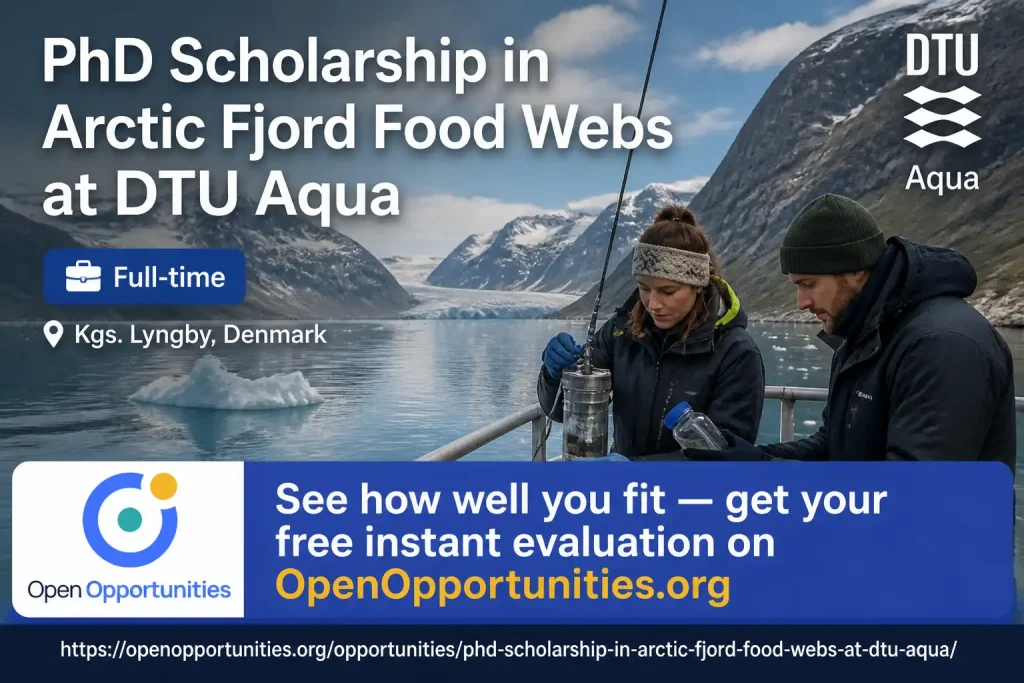
The Greenland Institute of Natural Resources (GINR), the Greenland Climate Research Centre (GCRC), and DTU Aqua are seeking a PhD candidate for a joint project investigating the impact of glacial retreat on Arctic fjord food webs. This position is part of the Independent Research Fund Denmark project ‘Fjords on the EDGE’. The research focuses on two contrasting fjord systems near Nuuk, Greenland, to understand how changes at the glacier-ocean interface propagate through the ecosystem. The candidate will conduct fieldwork in 2027, perform stable isotope and stomach-content analyses, and develop ecosystem models using the StratE2E framework. The role is a three-year, full-time appointment, with the first two years based in Nuuk and the final year at DTU Aqua in Lyngby.
Salary and benefits
- Full-time, three-year PhD appointment with salary based on the collective agreement with the Danish Confederation of Professional Associations
- Opportunity to conduct interdisciplinary research across Arctic field ecology, laboratory analysis, and ecosystem modelling
- Access to state-of-the-art research facilities and an ocean-going research vessel
- Support from GINR for finding accommodation in Nuuk
- Integration into an international research environment with access to the EDGE project network
Who can apply?
- Two-year master's degree (120 ECTS) in marine biology, marine ecology, fisheries science, ecosystem modelling, or a related field
- Strong interest in Arctic marine ecosystems and interdisciplinary research
- Demonstrated experience with quantitative data analysis and scientific programming in R, Python, or MATLAB
- Fluency in written and spoken English
- Ability to work effectively on ocean-going research vessels in Arctic environments
Required documents
- Cover letter motivating the application
- Curriculum vitae
- Grade transcripts and BSc/MSc diploma (in English) including official description of grading scale
When to apply
- Application deadline: 2026-11-30 (23:59 Danish time)
- Expected start date: 2027-02-01
How to apply
- Prepare all required documents as a single PDF file
- Access the official job portal via the 'Apply now' link on the job page
- Fill out the online application form and upload the single PDF file
Additional information
- Candidates may apply before obtaining their master's degree but must have received it before the start date
- The position is subject to academic approval and enrolment in a DTU PhD programme
- Open-source background checks may be conducted due to research in critical technology
- Applicants may attend a monthly 'PhD relocation to Denmark and startup' Zoom seminar hosted by DTU
Our Take on This Opportunity
This section reflects Open Opportunities’ own analysis of the opportunity from an applicant’s perspective.
You may be a strong fit if…
- Candidates with a background in marine ecology who are comfortable with both field-based data collection and quantitative ecosystem modelling
- Researchers eager for a unique, split-location experience that combines two years of Arctic fieldwork in Greenland with one year of academic research in Denmark
- Applicants with prior experience in stable isotope ecology, fish diet analysis, or the StratE2E framework
What should you think carefully about?
- The role requires significant mobility, involving a two-year commitment to living and working in Nuuk, Greenland, followed by a move to Lyngby, Denmark
- The position is a fixed-term, three-year contract, which is standard for PhD programmes but requires careful planning for post-doctoral career transitions
- While GINR assists with finding housing in Nuuk, the candidate should be prepared for the logistical challenges of relocating to and working in remote Arctic environments
How could this fit your current goals and plans?
This position is an excellent fit for early-career researchers aiming to build a profile in Arctic marine science. It offers a rare blend of hands-on field experience in a high-latitude environment and advanced computational modelling skills. For those interested in climate change research, the project provides a direct, high-impact opportunity to contribute to understanding ecosystem resilience in a rapidly changing region.
Our take
This is a highly attractive opportunity for marine biology or ecology graduates who want to combine field research with quantitative modelling. It is particularly well-suited for those who are adventurous and comfortable with international relocation. Candidates who prefer a single, stable location for the duration of their PhD may find the split-site requirement less suitable.
Ready to apply?
Review the opportunity on the official website before applying.
Official-source verified