About the opportunity
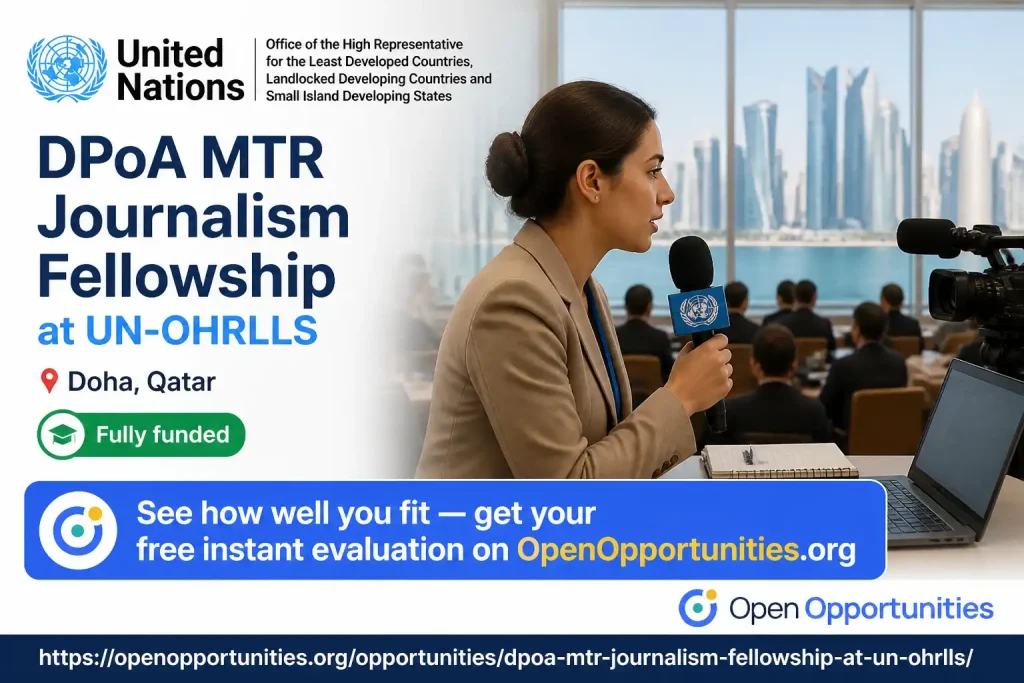
The DPoA MTR Journalism Fellowship, organized by UN-OHRLLS, offers 10 journalists from Least Developed Countries (LDCs) the opportunity to attend and report on the High-level Midterm Review of the Doha Programme of Action. This event is a critical moment to assess progress, identify gaps, and strengthen partnerships for sustainable development. Fellows will gain access to briefings and networking opportunities, and are expected to produce three substantive journalism outputs—before, during, and after the conference—that connect global commitments to national realities. The fellowship aims to amplify the voices of LDCs and build public understanding of the DPoA’s six priority areas, including poverty eradication, science and technology, structural transformation, trade, climate resilience, and international solidarity.
Funding and benefits
- Round-trip economy-class travel to Doha, Qatar
- Daily subsistence allowance for accommodation and meals
- Participation in pre-conference orientation activities
- Access to exclusive fellowship briefings and networking opportunities
Who can apply?
- Must be 18 years of age or older
- Must be a national of one of the 44 designated Least Developed Countries
- Must be a bona fide journalist with work regularly published or broadcast by a recognized media outlet (staff or freelance)
- Must have at least two years of professional journalism experience
- Must be willing and able to travel to Doha for the duration of the Midterm Review and participate in all required activities
Required documents
- Short biography (maximum 300 words) detailing professional position, media affiliation, years of experience, reporting expertise, languages, and relevant experience
- Two published work samples (print, online, radio, television, or multimedia), with at least one addressing development-related issues
- Reporting proposal (maximum 400 words) outlining story angles, relevance to LDC audiences, intended formats, and publication strategy
When to apply
- Application deadline: 30 November 2026
- Open call: 27 September – 19 November 2026
- Eligibility and scoring: 22 November – 17 December 2026
- Award letters sent: Before 31 December 2026
How to apply
- Review eligibility requirements and prepare all required materials
- Submit the application through the official online portal by the deadline
- Wait for notification of selection results
Additional information
- Fellows must share publication links for their three required outputs by 30 April 2027
- Selection does not guarantee conference accreditation, visa issuance, or travel clearance
- Applicants retain ownership of their work but grant UN-OHRLLS a non-exclusive license for non-commercial program and promotional use
- The 44 eligible countries include Afghanistan, Angola, Bangladesh, Benin, Burkina Faso, Burundi, Cambodia, Central African Republic, Chad, Comoros, Democratic Republic of the Congo, Djibouti, Eritrea, Ethiopia, Gambia, Guinea, Guinea-Bissau, Haiti, Kiribati, Lao People’s Democratic Republic, Lesotho, Liberia, Madagascar, Malawi, Mali, Mauritania, Mozambique, Myanmar, Nepal, Niger, Rwanda, Senegal, Sierra Leone, Solomon Islands, Somalia, South Sudan, Sudan, Timor-Leste, Togo, Tuvalu, Uganda, United Republic of Tanzania, Yemen, and Zambia
Our Take on This Opportunity
This section reflects Open Opportunities’ own analysis of the opportunity from an applicant’s perspective.
You may be a strong fit if…
- Journalists currently working in LDCs who have a proven track record of covering development, social, or economic issues.
- Professionals looking to expand their international reporting portfolio and gain direct access to high-level UN policy discussions.
- Reporters who can demonstrate a clear, actionable plan for how their coverage will reach and inform audiences within their home countries.
What should you think carefully about?
- The fellowship requires a significant commitment to produce three specific pieces of journalism within a tight timeframe, including pre- and post-conference work.
- While travel and subsistence are covered, fellows are responsible for their own passport and visa arrangements unless otherwise specified in the award letter.
- Participation is subject to administrative and travel formalities; selection does not automatically guarantee entry into Qatar.
How could this fit your current goals and plans?
This fellowship is an excellent opportunity for journalists to gain high-level international experience and deep subject-matter expertise in sustainable development. It serves as a platform to elevate one's professional profile while contributing to the global discourse on the Doha Programme of Action. Whether you are looking to pivot into international policy reporting or simply want to bring global development issues to your local audience, this program provides the necessary access and financial support to make that reporting possible.
Our take
This is a highly suitable opportunity for experienced journalists from LDCs who are passionate about development issues and have a concrete plan for impactful reporting. It is less suitable for those who cannot commit to the full reporting schedule or who lack the required two years of professional experience.
Ready to apply?
Review the opportunity on the official website before applying.
Official-source verified