About the opportunity
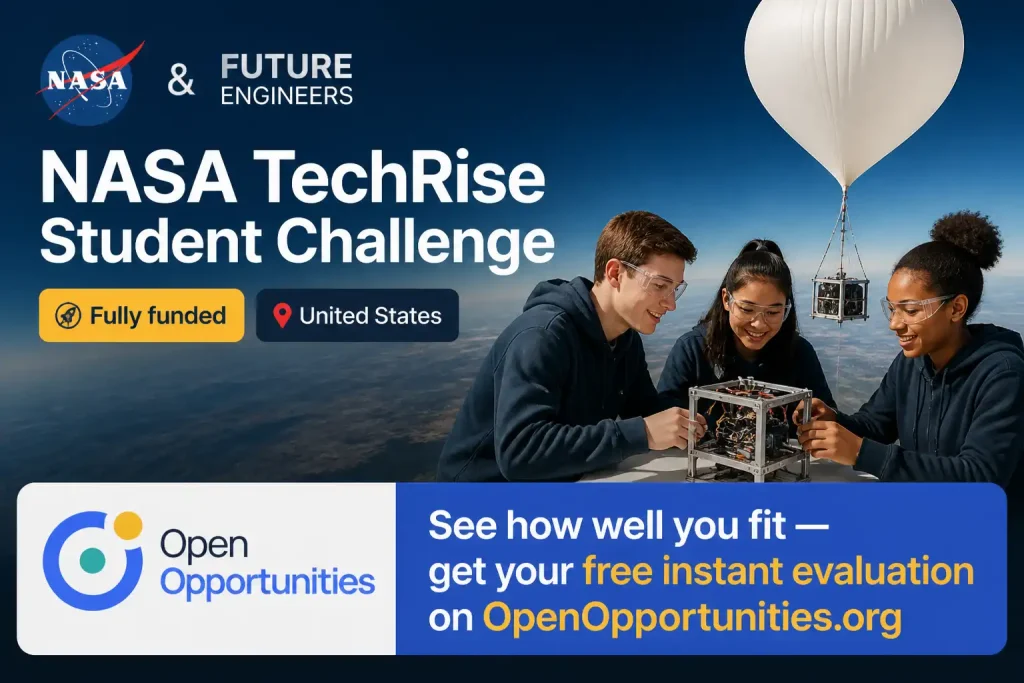
The NASA TechRise Student Challenge, managed by NASA’s Flight Opportunities program at Armstrong Flight Research Center and administered by Future Engineers, offers sixth to 12th-grade students across the United States and U.S. territories hands-on engineering and science experience. Student teams design an innovative experiment to test aboard a high-altitude balloon operating at 70,000 to 95,000 feet for four to eight hours in Earth’s upper atmosphere. A total of 60 winning teams are selected to bring their experiment to life, receiving build funding, equipment starter kits, and weekly mentorship from engineering advisors before launching their experiment on a NASA-sponsored flight.
Funding and benefits
- $1,500 award per winning team to build the proposed experiment
- A winner's starter kit, including a designated flight box in which to build the experiment
- An assigned flight spot to test the experiment on a NASA-sponsored high-altitude balloon flight (4 to 8 hours at 70,000 to 95,000 feet)
- Virtual mentoring and weekly technical support during the build phase from Future Engineers advisors
Who can apply?
- Open to teams of students in grades 6 through 12 attending public, private, or charter schools in U.S. states and territories
- Teams must consist of at least four students and one team lead who is a teacher or school employee
- There is no maximum number of students per team, and students may be from a single grade or across multiple grades within the same school
- Homeschools are not eligible unless affiliated with a public, private, or charter school that meets the stated insurance requirements
- No prior engineering or technical experience is required to participate
Required documents
- Completed proposal submitted using the official NASA TechRise Proposal Template
When to apply
- Contest opens: September 3, 2026
- Student Virtual Field Trip: September 22, 2026 at 11:00 AM PT
- Proposal submission deadline: November 2, 2026 at 11:59 PM PT
- Winners announced & experiment build period begins: January 19, 2027
- Winner showcase: May 18, 2027
- Deadline to mail completed experiments to Future Engineers: May 19, 2027
- Experiments launch: Summer 2027
How to apply
- Form a school team consisting of at least four 6th–12th grade students and one teacher/employee team lead
- Have the teacher or team lead register via the teacher sign-up portal on Future Engineers
- Review the Challenge Rules, Educator Guide, High-Altitude Balloon Design Guidelines, and Proposal Example & Template
- Brainstorm and design a science or technology experiment suitable for the flight box and high-altitude balloon conditions
- Draft the experiment proposal using the NASA TechRise Proposal Template
- Have the teacher submit the final proposal through the Future Engineers dashboard on or before November 2, 2026 at 11:59 PM PT
Additional information
- A total of 60 winning school teams will be selected nationwide
- Educators and schools may submit an unlimited number of proposals for multiple teams, but each proposal must be unique
- Proposals are evaluated on: Impact of experiment on team's education (40 points), Connection of experiment to NASA's mission (20 points), Alignment of experiment to team's hypothesis (20 points), and Design of the experiment meets design guidelines (20 points)
- Administered by Future Engineers and managed by NASA's Flight Opportunities program at Armstrong Flight Research Center in Edwards, California
Our Take on This Opportunity
This section reflects Open Opportunities’ own analysis of the opportunity from an applicant’s perspective.
You may be a strong fit if…
- U.S. school teams (grades 6-12) with a supportive teacher lead.
- Students interested in atmospheric science, engineering, or technology.
- Teams capable of committing to a build period and weekly virtual mentoring.
- Beginners in engineering; no prior technical experience is required.
What should you think carefully about?
- Teams must include at least four students and a teacher/school employee lead.
- Homeschooled students are only eligible if affiliated with a school that meets insurance requirements.
- The project timeline is long, extending from a proposal in November 2026 to a launch in Summer 2027.
How could this fit your current goals and plans?
This is a fantastic opportunity for students to gain hands-on experience in the STEM field. By designing an experiment for a high-altitude balloon flight, students can move from theoretical science to practical engineering, receiving mentorship and funding to see their work reach the upper atmosphere.
Our take
Middle and high school students in the U.S. who are curious about aerospace engineering and have a teacher's support, should seriously consider applying.
Ready to apply?
Review the opportunity on the official website before applying.
Official-source verified