About the opportunity
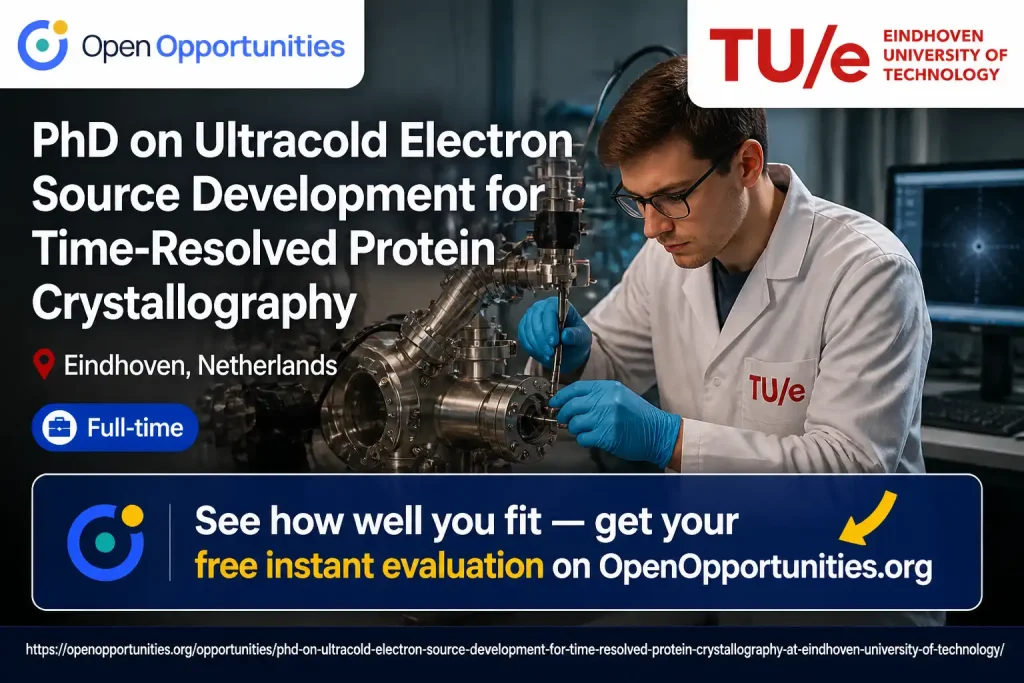
This PhD position is part of the ERC-funded project ‘Cool T-ReX’, which aims to develop a world-first laboratory-scale instrument for time-resolved protein crystallography using electrons. The successful candidate will drive the development of a pulsed electron source with extreme transverse bunch brightness, based on the photo-ionization of laser-cooled atoms. This research will enable the creation of ‘molecular movies’ of protein conformational changes, providing unprecedented spatial and temporal resolution. The candidate will work within the Coherence and Quantum Technology group, collaborating with a team of technicians, a second PhD student, a PostDoc, and the PI, Julius Huijts.
Salary and benefits
- Full-time employment for four years with a gross monthly salary between €3,204 and €4,051.
- 8% holiday allowance and 8.3% year-end bonus.
- Generous leave options, starting at 29 days per year with the possibility to increase to 41 days.
- Participation in the ABP pension scheme.
- Access to high-quality training programs and professional development support.
- Commuting, working from home, and internet cost allowances.
- Support for international candidates, including a Staff Immigration Team and a tax compensation scheme (Expat Scheme).
- Access to on-campus sports facilities, childcare, and 24/7 mental health support via OpenUp.
Who can apply?
- MSc degree in Applied Physics, Engineering Physics, Mechatronics (with a strong physics component), or a similar field.
- Proven affinity with at least two of the following: mechanical and optical design, complex optical setups, charged particle optics, cold atoms, high vacuum, or high voltage.
- Fluent in spoken and written English (C1 level).
- Ability to work in a team, take initiative, and organize own workload.
- Research-oriented attitude.
Required documents
- Cover letter describing motivation and qualifications.
- Curriculum vitae including a list of publications.
- Contact information for three references.
When to apply
- Application deadline: 2026-11-21.
- Ideal starting date: 2027-02-01.
How to apply
- Submit a complete application via the official online portal using the 'Apply' button.
- Ensure all requested documents are included; incomplete applications may not be prioritized.
- Notify your references that they may be contacted during the recruitment process.
Additional information
- The position involves a minimum of 10% and a maximum of 15% teaching tasks per year.
- A pre-employment screening, including a knowledge security check, may be part of the selection process.
- The project is funded by the European Research Council (ERC) under project number 101304364.
- Applications sent by email or post will not be processed.
Our Take on This Opportunity
This section reflects Open Opportunities’ own analysis of the opportunity from an applicant’s perspective.
You may be a strong fit if…
- Candidates with a strong background in experimental physics, particularly in optics, vacuum systems, or cold atom physics, will find this project highly aligned with their technical expertise.
- Individuals who thrive in collaborative, interdisciplinary research environments and are motivated by high-impact, 'world-first' scientific instrumentation projects.
- Applicants seeking a structured, well-supported PhD program with clear career development support and international networking opportunities.
What should you think carefully about?
- The role requires a significant commitment to both research and teaching (10-15% of time), which should be balanced with the ambitious technical goals of the project.
- The position is based in Eindhoven, Netherlands; while the university provides support for international staff, candidates should be prepared for the relocation process.
- The selection process may include a knowledge security check, which is a standard procedure for certain research roles in the Netherlands.
How could this fit your current goals and plans?
This position is an excellent opportunity for a researcher looking to bridge the gap between fundamental physics and medical application. It offers the chance to work on a high-profile, ERC-funded project that could define the future of protein crystallography. For a PhD candidate, this role provides not only a stable, well-funded environment but also the opportunity to contribute to a breakthrough technology that has the potential to influence medical research globally.
Our take
This is a highly attractive opportunity for ambitious MSc graduates in physics or engineering who want to work on cutting-edge instrumentation. It is particularly suitable for those who enjoy hands-on experimental work and are eager to contribute to a collaborative, high-tech research environment. Candidates should ensure their application highlights their specific technical skills in the requested areas to stand out.
Ready to apply?
Review the opportunity on the official website before applying.
Official-source verified