About the opportunity
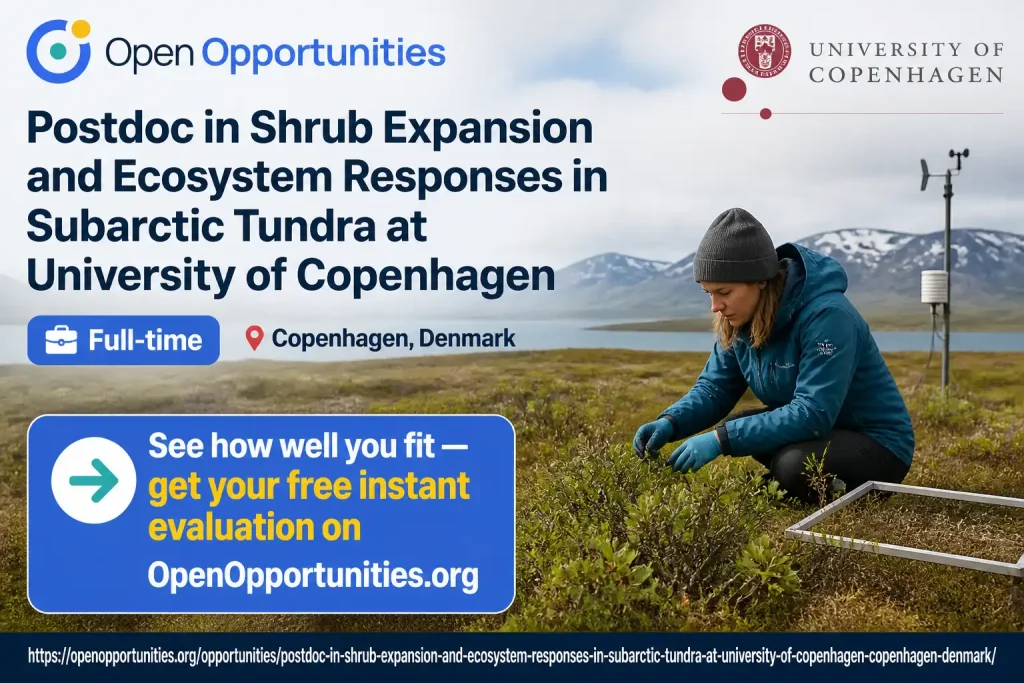
The Terrestrial Ecology Section within the Department of Biology at the University of Copenhagen offers a 2-year postdoctoral fellowship starting January 16, 2027, or as soon as possible thereafter. The position focuses on a research project assessing the role of shrubs as drivers of ecosystem changes in the Subarctic. The successful candidate will conduct field and laboratory analyses to understand vegetation changes, nitrogen cycling, and carbon sequestration in subarctic tundra heath ecosystems. The work includes field visits to long-term experimental sites near Abisko in Northern Sweden, collaboration with the University of Antwerp, and extensive laboratory work in Copenhagen. The host research group focuses on Plant Physiological Ecology & Biogeochemistry and is led by Professor Anders Michelsen.
Salary and benefits
- Fully funded 2-year postdoctoral employment contract.
- Salary, pension, and other conditions set in accordance with the Agreement between the Ministry of Finance and AC (Danish Confederation of Professional Associations) or other relevant organization.
- Opportunity for a negotiated salary supplement depending on qualifications.
- Collaborative research environment within a top-ranking European university and the International Alliance of Research Universities (IARU).
Who can apply?
- Hold a PhD in plant ecology, biology, biogeochemistry, or a related field.
- Solid experience with field and lab-based experimental work, and data analysis/statistics.
- Fluency in written and spoken English, with excellent writing skills demonstrated by a publication record.
- Experience with analyses of plant traits, ecosystem responses, and/or biogeochemical responses to environmental changes.
- Demonstrated interest in the use of stable isotopes in ecology.
- Ability to work independently as well as possess good interpersonal skills.
Required documents
- A cover letter including a statement of research interests, reasons for applying, and a few selected concrete proposals/ideas for possible novel and relevant research work within the topics of the project (maximum 2 pages).
- Curriculum vitae including a list of publications.
- Copy of the PhD diploma or documentation for a planned PhD defense.
- Separate reprints of 3 particularly relevant papers.
- Upload or link to the PhD thesis.
- Maximum 2 letters of reference.
When to apply
- Application deadline is November 1, 2026, at 23:59 GMT +1.
- Interviews are scheduled to take place around the end of November 2026.
- Employment is set to begin on January 16, 2027, or as soon as possible thereafter.
How to apply
- Prepare all required application documents in English, including cover letter, CV, PhD documentation, publications, PhD thesis, and reference letters.
- Submit the application electronically by clicking the apply link on the official University of Copenhagen job portal before the deadline.
Additional information
- The position involves fieldwork in Abisko, Northern Sweden, for short periods totaling up to 3 weeks in spring/summer, which may be conducted alone or with hosts and collaborators.
- A research visit at the University of Antwerp is included in the project.
- Much of the field sampling has already been performed, so the work will heavily emphasize processing biological material, data interpretation, and writing scientific publications.
- The University of Copenhagen is an equal opportunity employer.
Our Take on This Opportunity
This section reflects Open Opportunities’ own analysis of the opportunity from an applicant’s perspective.
You may be a strong fit if…
- Early-career researchers holding a PhD in plant ecology, biogeochemistry, or biology looking to build an academic publishing record.
- Scientists experienced in stable isotope analysis, plant traits, or subarctic/arctic ecosystem responses.
- Researchers eager to combine field data from established long-term Scandinavian experiments with advanced laboratory analyses and international collaboration.
What should you think carefully about?
- The contract is fixed-term for exactly 2 years, requiring future career planning beyond the fellowship.
- Short-term fieldwork in remote Subarctic Sweden (up to 3 weeks) is required, alongside research visits in Belgium and primary placement in Denmark.
- Applicants must already hold a relevant PhD or have a documented defense planned.
How could this fit your current goals and plans?
This postdoctoral position is ideal for researchers seeking to deepen their specialization in terrestrial ecology, climate change impacts, and biogeochemistry through high-impact international collaboration. It offers a structured runway to produce peer-reviewed publications and expand European academic networks.
Our take
Ambitious researchers with a strong background in plant ecology and a desire to investigate climate feedbacks in subarctic ecosystems should seriously consider applying before the November 2026 deadline.
Ready to apply?
Review the opportunity on the official website before applying.
Official-source verified